The Cutlery Detection System marks an important step in how Hartera Robotics applies robotics and computer vision to real industrial use cases. Developed in collaboration with AK Wrap, a respected Croatian automation company working on advanced silverware wrapping systems for major cruise industry clients such as MSC, the project addressed a practical and technically demanding challenge inside an existing machine workflow.
The core need was clear: the automation process had to become more adaptable when working with different spoon, fork, and knife types. In industrial environments, even small variations in object shape, orientation, and presentation can create significant challenges for a machine that must operate reliably and repeatedly. Without intelligent sensing, these situations often lead to greater mechanical complexity, more difficult tuning, and reduced flexibility across the overall system.
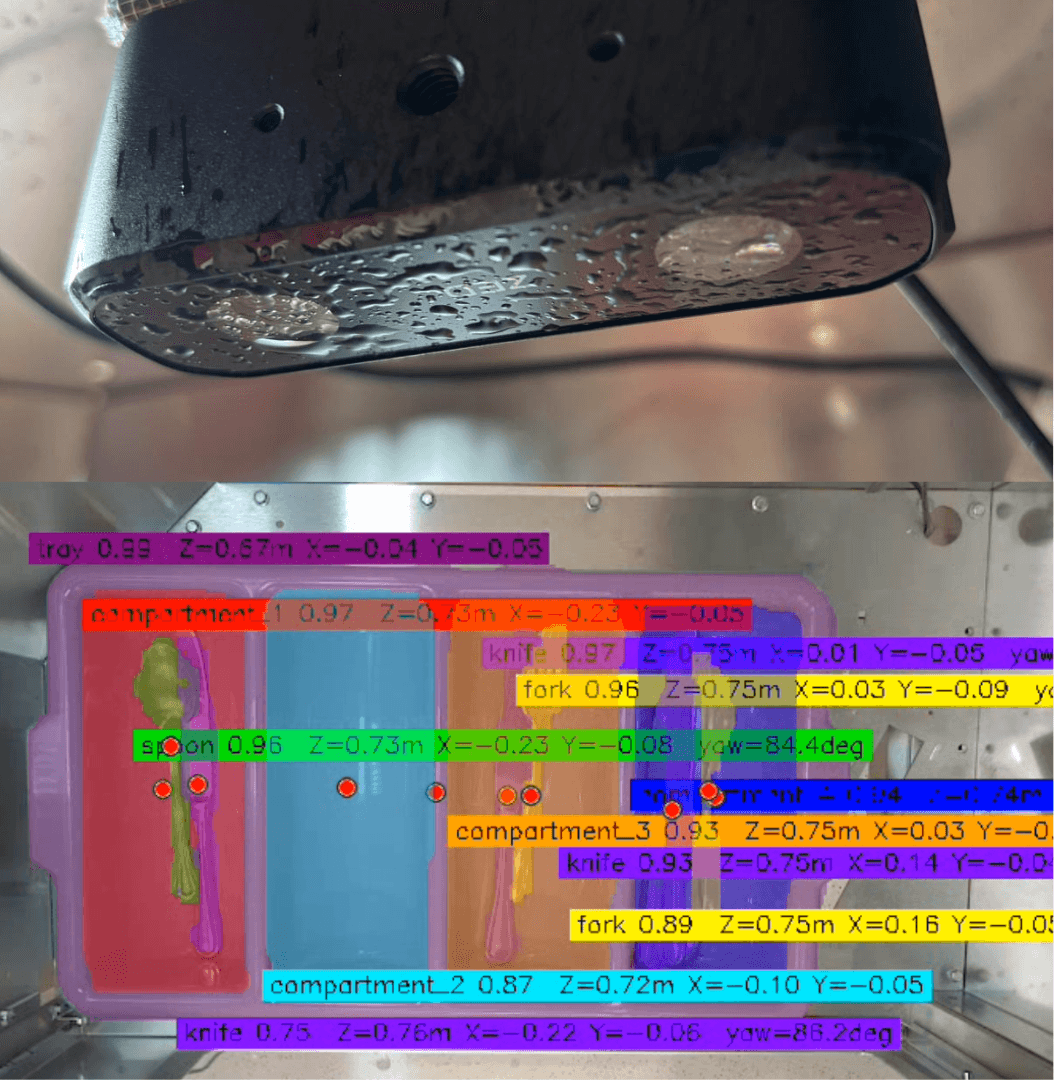
Hartera Robotics approached this problem through a vision-based engineering solution designed for real deployment. The Cutlery Detection System was developed to identify different cutlery types, determine their position, and provide depth-related information that could support more reliable downstream machine logic. Beyond detection alone, the system was also designed with verification and fallback handling in mind, helping the broader workflow respond more safely and robustly when operational edge cases appear.
The project combined computer vision, software architecture, industrial integration, and ROS 2-based communication into one structured solution. Rather than treating vision as an isolated add-on, the system was developed as part of a wider machine-level process in which reliability, timing, interoperability, and maintainability all matter. That system-level mindset is what made the solution valuable: it was not only about recognizing objects, but about making the machine workflow more aware and more capable under real production conditions.
For Hartera Robotics, this collaboration was also an important demonstration of how advanced engineering can create measurable value in established industrial environments. By integrating machine vision into an automation process already serving high-level cruise industry applications, the project showed that robotics and software-driven intelligence are increasingly necessary not only in research or prototypes, but in practical systems that support everyday operations at scale.
The result was a more robust and scalable automation approach, with reduced dependency on rigid mechanical-only solutions and improved adaptability under variable conditions. The Cutlery Detection System reflects the wider direction of Hartera Robotics: combining software, electronics, sensing, and automation logic into real-world systems that solve specific operational problems with technical depth and practical impact.